






Crane Limit Switch LX33 - High-Quality AC & DC Control Solutions from China Suppliers and Factory
Advantage
Type Meaning
The limit switch is divided into the following forms according to different usage methods:
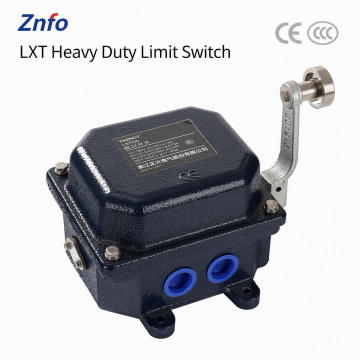
- LX33-1 rod-shaped operating arm automatic reset type, referred to as rod type;
- LX33-2 fork-shaped operating arm non-automatic reset type, referred to as fork type;
- LX33-3 heavy hammer type;
- LX33-4 rotary;

Working Conditions
- The upper limit of ambient air temperature is 40℃;
- The lower limit of ambient air temperature is not lower than -5℃;
- The 24-hour average ambient air temperature does not exceed 35℃.
- Altitude: The altitude of the installation site does not exceed 2000m.
- Mixing degree: The relative humidity of the air does not exceed 50% when the optimal temperature is 40°C. It can have higher relative humidity at lower temperatures. The monthly average minimum temperature of the wettest month does not exceed 25°C. The monthly average temperature of the wettest month does not exceed 25°C. The average maximum relative humidity does not exceed 90%. Condensation that occurs on products due to temperature changes requires action.
Construction Introduction
The travel switch is mainly composed of a contact group, a camshaft, a shell, etc. The contact breaking is realized by the rotation of the camshaft driven by a motor mechanism. The contact group structures are all rotary double breakpoints, rod type, fork type, and heavy bell type. The limit switch can be equipped with one or two sets of contact groups to form a single circuit (one normally closed) or a double circuit (one normally open, one normally closed) opening and closing form. In actual application, the user can adjust the cam angle as needed. You can change the contact opening and closing mode. The rotary limit switch can be installed with four contact groups at the same time, so that it can have secondary protection when it rises or falls. In practical applications of the rotary limit switch, if you need to control the lift of the lifting mechanism, you only need to pull out the positioning pin, turn the nut, and adjust the screw nut mechanism to change the lift of the lifting mechanism.
Main Technical Parameters

A contact group (2) is installed in the travel switch housing, and the moving contact and the stationary contact thereof drive the cam on the switch shaft (4) to open and close the contacts as the operating arm (3) rotates. The positioning of the operating arm is achieved by means of a positioning member (5), a positioning spring (6), a positioning lever (7) and a roller (8).
Use and Maintenance


Appearance and Installation Dimensions
See Figure 5 and Figure 6 for appearance and installation dimensions.

Frequently Asked Questions (FAQ)
What are the different types available in the LX33 limit switch series?
The series includes LX33-1 (rod-shaped operating arm, automatic reset), LX33-2 (fork-shaped operating arm, non-automatic reset), LX33-3 (heavy hammer type), and LX33-4 (rotary type).
What are the electrical ratings and operating voltage limits?
The rated working voltages are AC 380V (AC-15: 380V / 2.6A) and DC 220V (DC-13: 220V / 0.4A), with an agreed heating current (Ith) of 10A and rated insulation voltage (Ui) of 400V.
What is the mechanical lifespan and operating frequency?
The mechanical service life is not less than 1 million operations, with a rated operating frequency capability of up to 300 times per hour.
What are the installation environmental requirements?
It operates within an ambient temperature range of -5℃ to +40℃ (24-hour average ≤ 35℃) and an installation altitude up to 2000 meters under Level 3 pollution and Category II installation ratings.
Can the contact operation and opening/closing angles be adjusted?
Yes. Users can adjust the cam angle as required to alter contact opening and closing modes, configuring single circuit (1NC) or double circuit (1NO + 1NC) setups.
What enclosure protection grade does the switch offer?
The switch features an IP44 shell protection rating and utilizes RT16-10A fuse protection for rated limited short-circuit tests.