







Introduction of deviation switch
- Working principle: The deviation switch has a two-level angle design, generally the first-level angle is 10°, 12°, 20°, etc., and the second-level angle is 30°, 35°, 45°, etc. When the conveyor belt deviates, its edge pushes the switch roller to deflect, and an alarm signal is issued when it reaches the first-level angle. If it continues to deviate to the second-level angle, a stop signal is issued. After the fault is eliminated, the roller automatically resets.
- Classification:
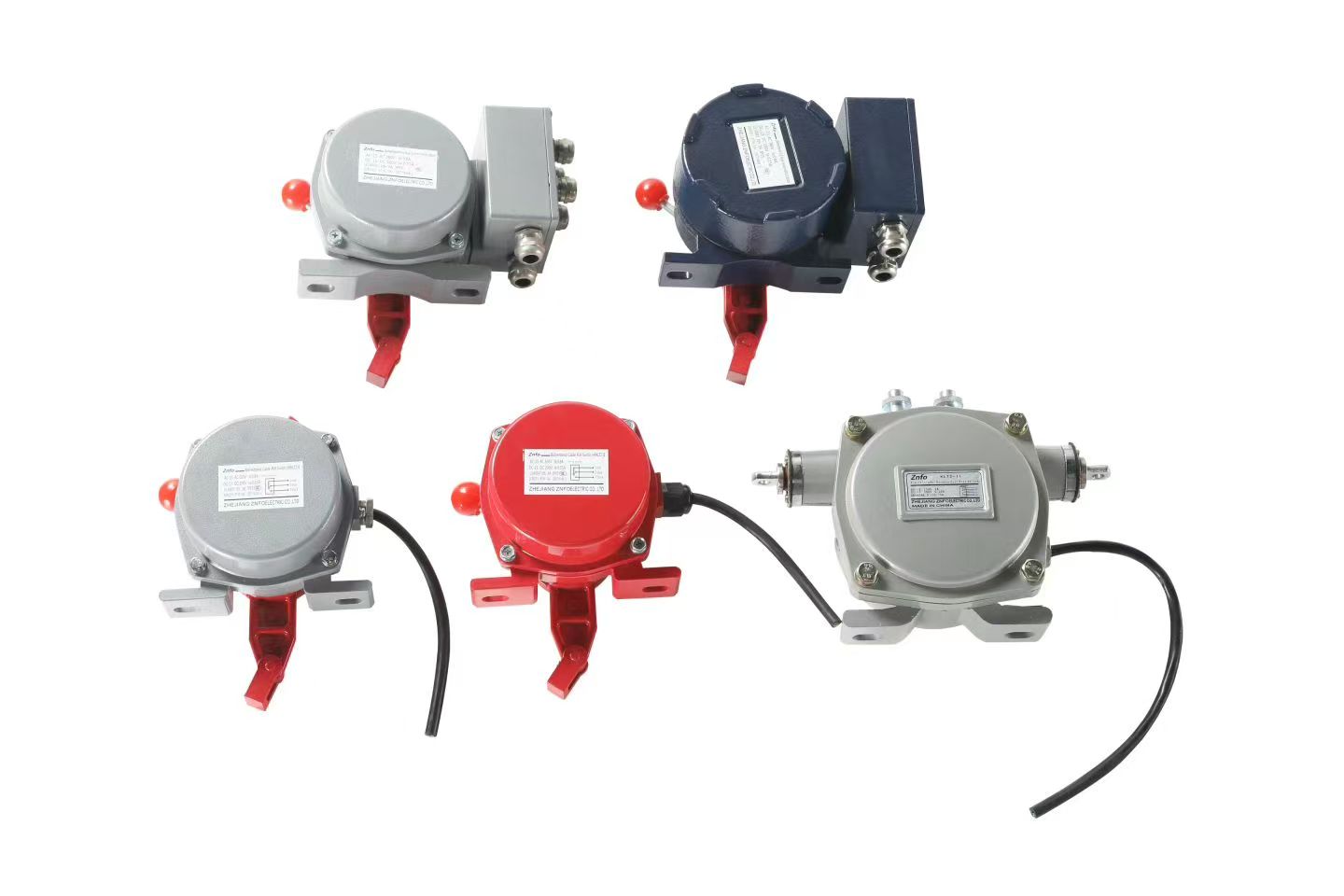
- Ordinary type: It is a common two-stage deviation switch with a simple structure, used for general belt conveyor deviation detection.
- Wiring cavity type: A waterproof wiring cavity is added on the basis of the ordinary type to facilitate the direct access of on-site control cables. It is suitable for places with harsh environments that require waterproofing and dustproofing.
- Address coding type: Integrates XLline fieldbus technology and has address coding function, which can realize remote monitoring of long-distance belt conveyors, facilitate centralized management and troubleshooting.
- Installation and adjustment:
- Installation position: It should be installed on both sides of the conveyor belt, with the vertical rollers perpendicular to the edge of the conveyor belt, and both sides of the conveyor belt are at one-third of the height of the vertical rollers. The normal distance between the vertical rollers and the conveyor belt is 50-100 mm.
- Quantity configuration: According to the length, type and layout of the conveyor, switches are set at the head, tail, convex arc section, concave arc section and middle section. For longer conveyors, a pair can be set every 30-35 meters in the middle section.
- Fixing method: Connect the bracket to the middle frame of the conveyor through the installation bracket. The bracket is welded to the frame after the conveyor is installed, and the switch is fixed to the bracket with bolts.
- Application fields: Deviation switches are widely used in the fields where belt conveyor equipment is used in metallurgy, coal, cement building materials, mining, electric power, ports, metallurgy and chemical industry, etc.
- Performance characteristics:
- Timely detection: The two-level angle design can detect different degrees of deviation problems in time so that corresponding measures can be taken.
- Simple structure: It is mainly composed of vertical roller, Travel Switch, shell, etc. It has no complicated structure and is easy to maintain and replace.
- Automatic reset: After the conveyor belt resumes normal operation, the switch rollers can automatically reset, reducing manual intervention and improving work efficiency.
- Remote monitoring: Address-coded products use XLline fieldbus technology to support remote monitoring and multi-point address sharing, simplifying the troubleshooting process and improving the level of intelligent equipment management.